
Quick Verdict
Jeff Brown’s latest presentation lays out Elon Musk’s three-step plan to dominate AI—controlling the chips via Terafab, the energy via orbital AI satellites, and the physical applications via Cybercabs and Optimus robots. Brown argues this could unlock $320 trillion in new wealth and positions three lesser-known supplier stocks as the practical way for individual investors to participate. The accompanying offer gives 30-day risk-free access to his Near Future Report plus the three detailed research reports that name the stocks, tickers, and full analysis. For readers who follow high-conviction tech trends and accept the inherent risks of individual stock investing, the package is worth reviewing before any potential partnership announcements move the shares.
Key Takeaways
- Elon Musk has publicly projected that his AI initiatives could create $320 trillion in new wealth—enough, on paper, to send roughly $2.4 million to every U.S. household.
- The plan rests on three pillars: building 50 times more AI chips than the world currently produces (Terafab), powering them with up to one million AI data-center satellites, and deploying the resulting intelligence through autonomous vehicles and humanoid robots.
- Jeff Brown, a former senior executive at Qualcomm, NXP Semiconductors, and Juniper Networks, has previously flagged Tesla, Nvidia, Bitcoin, and SpaceX before their major runs. He now highlights three supplier companies he believes are positioned for each pillar.
- The current promotional offer delivers a full year of The Near Future Report (normally $499) plus three special reports valued at $199 each for $179, with a 30-day full refund and the right to keep all materials.
- Brown stresses urgency around a possible near-term Terafab partnership announcement, citing the earlier Intel collaboration that produced a sharp short-term move in that stock.
- All investing involves risk; past performance and analyst projections are not guarantees of future results.
Elon Musk’s 4th Generational Wealth Window Pitch
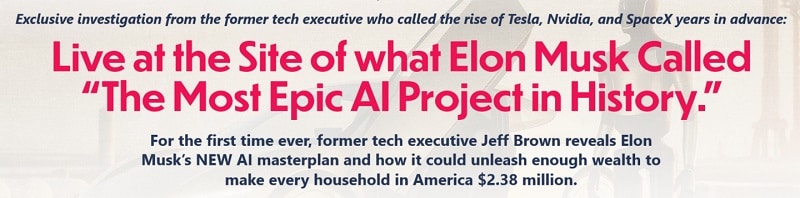
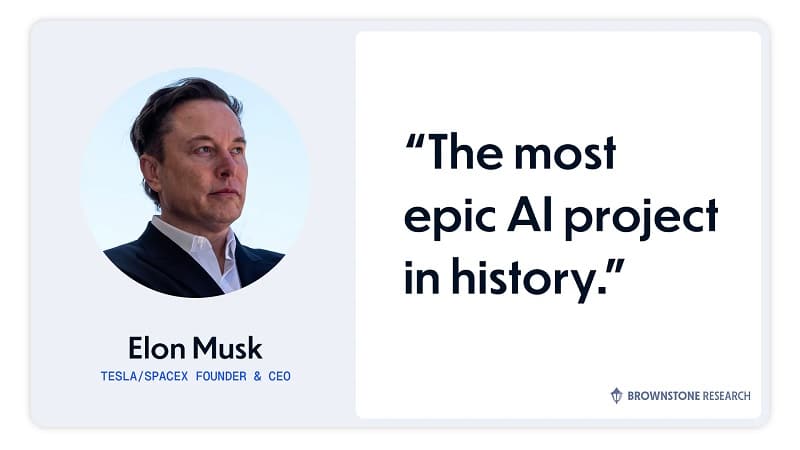
In the presentation, Jeff Brown takes viewers on a ride inside a Tesla Cybercab—an autonomous vehicle with no steering wheel, pedals, or mirrors—to the site of what Elon Musk has called “the most epic AI project in history.” The destination is the early phase of Tesla’s Advanced Technology Fab and the much larger planned Terafab facility. Brown uses the trip to frame a larger thesis: Musk is executing a coordinated, top-to-bottom strategy to control the critical inputs and outputs of artificial intelligence.
The thesis begins with a number Musk himself has put into the public record: $320 trillion in potential new wealth. Brown translates that figure into everyday terms—approximately $2.38 million for each of the roughly 134 million U.S. households. He repeatedly notes that the claim sounds extreme, then walks through Musk’s earlier projects that also sounded extreme at the time: digital payments with PayPal, electric vehicles and full self-driving with Tesla, and reusable orbital rockets with SpaceX. In each case, early participants who believed the technology would work captured outsized gains while many observers dismissed the plans as unrealistic.
Brown structures Musk’s current effort as a three-step blueprint.
Step 1 – Control the AI chips
Computing power is the foundation of modern AI. Musk has stated that existing global chip production covers only a small fraction of the capacity his companies will eventually need. Rather than compete for limited supply from Taiwan Semiconductor, Nvidia, AMD, or Intel, Tesla is building its own fabrication capability. The Advanced Technology Fab is the first phase; Terafab is the long-term goal—a facility large enough, according to the presentation, to produce up to 200 billion chips per year, or roughly ten times Taiwan Semiconductor’s current output and fifty times the entire industry’s present volume. Brown compares the planned scale of Terafab to the Texas Gigafactory, the Pentagon, and the Mall of America to convey the physical ambition. He argues that the company supplying the ultra-precise manufacturing equipment required for such a facility sits at a critical choke point. Because the same equipment has long been used by Intel, and because Musk has already toured related facilities, Brown expects an official partnership announcement in the near term. He points to the earlier Intel collaboration, after which that stock rose sharply in a matter of weeks, as a precedent for how markets can react.
Step 2 – Control the energy that powers the chips
Even if the chips exist, they require enormous amounts of electricity. Data centers already strain local grids; Goldman Sachs and others have labeled power availability the primary bottleneck for AI expansion. Traditional solutions—new gas turbines, nuclear plants, or large-scale terrestrial solar and wind—face multi-year lead times. Musk’s proposed workaround is to place AI compute in orbit. Starlink already operates thousands of satellites. The next generation, sometimes referred to as Starlink V3 or AI satellites, would carry high-performance chips powered continuously by sunlight and cooled by the extreme cold of space. No land-use conflicts, no local permitting fights, and no night-time power interruptions. The Federal Communications Commission has accepted filings that contemplate up to one million such satellites—roughly one hundred times the current Starlink constellation. Launch cost is the practical constraint. SpaceX’s reusable Falcon and Starship vehicles have already driven launch prices dramatically lower; further cost reductions of another order of magnitude would make orbital compute economically viable at scale. Brown highlights a long-standing SpaceX supplier that produces specialized “space chips” already flying on every Starlink satellite and ground terminal. With the constellation potentially expanding one-hundred-fold, that supplier’s volume opportunity expands accordingly.
Step 3 – Control the real-world applications
Raw computing power and energy become valuable when they produce useful products and services. Brown focuses on two physical AI platforms already in advanced development at Tesla: the Cybercab robotaxi and the Optimus humanoid robot.
The Cybercab is a purpose-built autonomous vehicle without traditional controls. Because Tesla’s Full Self-Driving system is vision-based rather than geofenced, the same software can operate anywhere the company has mapped or can map in real time. Vehicles already in the existing Tesla fleet can receive over-the-air software updates, creating the possibility of a rapid national rollout once regulators finalize safety standards. Pricing estimates shown in the presentation put a typical urban trip at roughly half the cost of a comparable Uber ride, with further declines expected as utilization rises. Brown notes that many prospective owners already sit on waitlists and that a small fleet of four vehicles could, under optimistic utilization assumptions, generate six-figure annual revenue while the vehicles largely pay for themselves.
Optimus represents the longer-term physical-AI opportunity. The third-generation design incorporates a highly articulated hand with twenty-five motors and flexible composite ligaments that approximate human tendon function. Combined with the same vision and navigation stack that has logged more than fifteen billion autonomous miles in Tesla cars, the robot is intended to perform general-purpose tasks in homes, factories, and other unstructured environments. Musk has projected multi-million-unit annual production and industry growth measured in millions of percent over a decade. Even if those forecasts prove substantially overstated, the absolute scale of a functional general-purpose humanoid market would still be large. Brown identifies a supplier whose power-management technology is already used in Tesla vehicles and is well suited to the dense, efficient motor control required by humanoid limbs. Multiple hedge funds and at least one major bank have already taken positions in the name, according to the presentation.
Taken together, the three steps form a closed loop: proprietary chips, proprietary orbital energy, and proprietary physical platforms that consume both. Brown’s central investment claim is that the public companies supplying critical enabling technology to each step offer more asymmetric upside, at current valuations, than simply buying Tesla or waiting for a SpaceX listing.
Who Is Jeff Brown: The Analyst Behind the Thesis

Jeff Brown spent more than two decades as a senior executive at three large publicly traded technology companies—Qualcomm, NXP Semiconductors, and Juniper Networks—whose combined annual revenue now exceeds $60 billion. He has also operated as an angel investor across hundreds of private technology deals, some of which returned several thousand percent. His formal education includes a degree in aeronautical and astronautical engineering from Purdue University, an institution that has produced more NASA astronauts than any other. Early in his career he worked as a contractor on the Boeing 777 program.
Brown’s public track record, as presented, centers on early identification of major technology shifts. He recommended Tesla shares in 2018 when the company was widely viewed as an overpriced car manufacturer rather than an AI and robotics platform; the stock subsequently rose more than twenty-fold from that period. He flagged Nvidia before its multi-year AI-driven advance, Bitcoin before its largest percentage moves, and SpaceX’s Starlink constellation years before commercial service began. He has consulted with officials at the Department of Commerce, the National Institute of Standards and Technology, and the Defense Intelligence Agency on technology policy matters.
The presentation repeatedly returns to a consistent pattern: technologies that look improbable to mainstream observers often become inevitable once engineering milestones are cleared. Brown positions the current $320 trillion AI blueprint as the latest example of that pattern and argues that the same analytical lens that previously identified Tesla, Nvidia, and SpaceX now points to three specific supplier companies.
The Near Future Report – What It Is and How It Works
The Near Future Report is Jeff Brown’s monthly investment research service focused on early-stage technology trends that have not yet reached saturation in mainstream coverage. Each issue delivers at least one new investment idea drawn from areas such as artificial intelligence, robotics, autonomous systems, advanced semiconductors, space infrastructure, and related enabling technologies. Subscribers also receive ongoing updates on previously recommended positions, access to a model portfolio that shows every open recommendation still considered within a buy range, and a digital archive containing every past issue and special report.
The service is designed for individual investors who prefer to evaluate ideas themselves rather than outsource decision-making to a managed product. Brown and his team provide the research, the rationale, the risk factors they see, and the valuation framework they use. Execution, position sizing, and timing remain the subscriber’s responsibility. Customer-support staff are available by phone and email during business hours to answer questions about the membership itself; they are not authorized to give personalized investment advice.
Weekly updates and urgent alerts are used when material news or price action affects open positions. The goal is to keep subscribers informed of both positive catalysts and potential reasons to reduce or exit a holding. The archive, branded The Digital Tech Vault in the current offer, allows new members to review historical recommendations and the reasoning behind them, providing context for the current portfolio.
What’s Included in the Current Offer
The promotional package bundles a full twelve-month membership to The Near Future Report with three special reports that expand on the presentation:
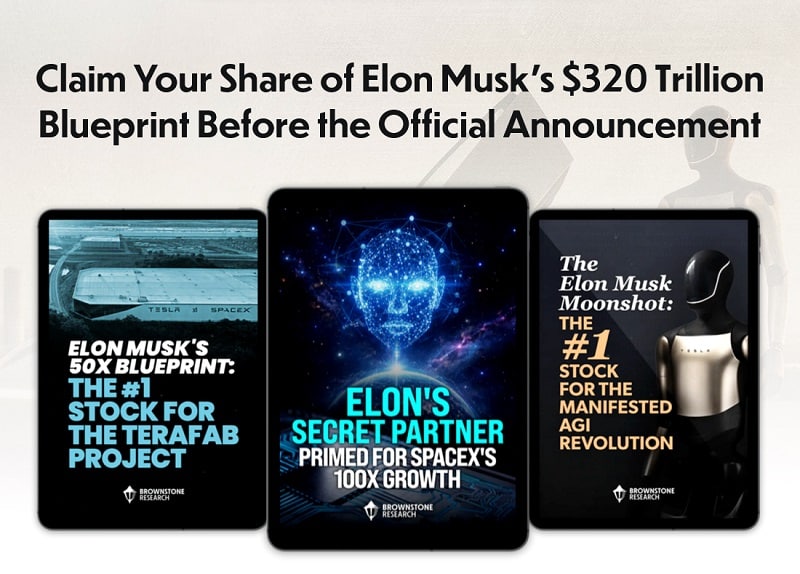
- Elon Musk’s 50X Blueprint: The #1 Stock for the Terafab Project – Identifies the equipment supplier Brown believes is best positioned for Tesla’s chip-manufacturing ambitions, including name, ticker, and full analysis.
- Elon’s Secret Partner Primed for SpaceX’s 100X Growth – Details the long-standing SpaceX supplier of specialized space-grade power and control chips and the volume implications of a one-million-satellite constellation.
- The Elon Musk Moonshot: The #1 Stock for the Manifested AGI Revolution – Covers the power-management and motor-control technology supplier that Brown expects to benefit from Optimus production ramp.
Additional membership features include 24/7 access to the model portfolio, the complete historical archive, weekly updates and alerts, and professional customer support.
Pricing
A standard one-year membership is listed at $499. The current offer reduces the price to $179—less than four dollars per week—while including the three special reports (stated value $199 each). The combined package is presented as a $1,096 value.
Guarantee
Subscribers receive a 30-day, 100 percent money-back guarantee. If the service does not meet expectations for any reason, a full refund is available by phone or email. All materials received during the trial period, including the three special reports and any issues published, remain the subscriber’s property.
Who the Offer Is For?
The package is aimed at individual investors who already follow technology and growth-stock themes, who are comfortable evaluating company-specific research, and who understand that early-stage or supplier-focused ideas can be volatile. It is not designed for investors seeking guaranteed returns, passive index exposure, or advice tailored to personal financial circumstances.
Readers who prefer to wait for broader consensus or regulatory clarity on Cybercab and Optimus may find the timing premature. Those who view Musk’s prior execution record as a positive signal and who want structured research on the enabling suppliers may find the combination of monthly ideas plus the three focused reports useful.
Pros and Cons
Pros
- Concentrated research on a high-profile, multi-year technology theme.
- Specific stock ideas with supporting analysis rather than general market commentary.
- Low entry price relative to the stated full retail value and a true no-questions-asked refund window.
- Retention of all materials even if the membership is canceled within 30 days.
- Ongoing portfolio updates that attempt to address both entry and exit considerations.
Cons
- Individual stock recommendations carry company-specific and market risk; losses are possible.
- The three featured ideas are not named in the public presentation; full details appear only inside the paid reports.
- Performance claims and historical examples are selective; the average gain cited for the service is 43 percent and is not typical of every recommendation.
- Success of the underlying thesis depends on Tesla and SpaceX executing complex manufacturing, regulatory, and launch schedules that remain subject to delay or failure.
- The service does not provide personalized portfolio construction or tax advice.
Conclusion
Jeff Brown’s presentation frames Elon Musk’s AI efforts as a coherent, vertically integrated plan spanning chips, energy, and physical applications. The scale of the stated ambitions—fifty times current global chip output, one million orbital compute satellites, and multi-million-unit robot production—creates corresponding opportunities for the specialized suppliers that enable each step. Brown’s own background in semiconductors, aerospace, and early identification of Tesla, Nvidia, and SpaceX supplies the analytical lens he applies to the current opportunity set.
The Near Future Report packages that analysis into a monthly research product, supplemented by three focused reports that name the specific stocks Brown favors for the Terafab, orbital-power, and humanoid-robot legs of the thesis.
At $179 with a full 30-day refund and permanent retention of the materials, the offer removes most of the financial friction of evaluating the ideas. Whether the $320 trillion wealth figure materializes, whether the partnership announcements arrive on the expected timetable, and whether the recommended suppliers capture the projected economics are questions only future execution and market prices can answer. For investors who want structured research on those questions before any potential news flow accelerates, the package provides a concrete starting point.